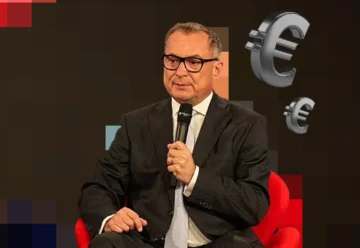
The European Central Bank (ECB) confirmed its plans to launch a digital euro pilot project in 2027 and announced that the selection of participants will begin in Q1 2026.
Piero Cipollone, Member of the ECB’s Executive Board, stated during a meeting of the Executive Committee of Associazione Bancaria Italiana (ABI) that the 12-month digital euro pilot is scheduled to start in H2 2027. At this stage, the regulator will focus on technical readiness, market engagement, and support for the legislative process.
Testing of the European central bank digital currency (CBDC) will take place in a controlled environment involving real transactions. A limited number of banks and other payment service providers (PSP), as well as merchants and Eurosystem staff, will participate. The selection process will begin in Q1 2026.
The pilot project will test various digital euro use cases. The initiative aims to verify the system’s technical readiness ahead of a large-scale rollout, refine the economic model, and clarify the go-to-market strategy.
The economic model is based on a four-party scheme similar to card payment systems. Issuing and acquiring banks will not pay transaction processing fees within the Eurosystem. Merchant fees will be capped, as will interchange fees between payment service providers. According to the ECB, this approach is expected to reduce costs for market participants, particularly amid the growing share of international card schemes and digital wallets.
The model includes several safeguards, including:
- holding limits;
- no interest paid on digital euro balances;
- automatic transfer of excess funds to a bank account;
- a prohibition on companies holding digital euros.
The digital euro will be distributed through banks and licensed payment service providers in the EU. Customers will access the digital euro through their banks, which, according to the ECB, will help preserve existing customer relationships and prevent liquidity outflows from the banking system.
Moreover, the digital euro can be integrated into existing payment solutions, including banking apps and physical co-branded cards. This would enable cross-border transactions within the euro area without paying fees to international card network operators.
In December 2025, the Council of the EU approved its position on the digital euro regulation. Final approval by the European Parliament is expected in 2026. Following a formal issuance decision, at least two years will be required before the actual launch of the digital euro.
Under the baseline scenario, the ECB aims to be ready for the first issuance in 2029. Thus, 2026 will be a key year for finalizing the legal framework, testing and refinements will take place in 2027–2028, and the full launch of the new form of European currency could occur in 2029.