
As the agentic economy evolves, a practical question is emerging: how will autonomous AI systems pay for the goods and services they find and use on their own? For example, if an AI agent can purchase computing resources independently, it needs a payment mechanism that can be embedded directly into its software workflow.
Stablecoins are increasingly being considered as a payment instrument for these use cases. Their appeal is driven primarily by the requirements the agentic economy places on payment infrastructure.
Payment Requirements of the Agentic Economy
AI agents can use traditional payment infrastructure, but it was designed primarily for transactions involving humans and only partially supports the functionality required for the continuous interaction between software systems that characterizes the agentic economy. In particular, payment instruments suitable for AI agents should allow them to:
- Initiate transactions programmatically
- Make payments around the clock
- Process frequent, low-value transactions
- Use a single payment instrument across different digital platforms
- Automatically verify receipt of funds
- Set spending limits and other conditions
- Settle transactions without requiring a separate payment integration for each new interaction
Stablecoins meet these requirements due to the properties of blockchain infrastructure. Payments can be initiated and verified programmatically, while the assets themselves can be used in transactions involving smart contracts and other programmable solutions.
It’s important to note that the speed and cost of stablecoin payments, settlement finality, and liquidity availability depend on the specific asset and blockchain ecosystem. The cross-border nature of the technology also doesn’t eliminate regulatory restrictions.
Limitations of Traditional Payment Mechanisms in the Agentic Economy
Stablecoins don’t offer a clear advantage in every agentic use case. If an AI agent books a flight or buys a product from an online store on behalf of a person, the transaction differs little from conventional e-commerce. The amount is relatively large, the merchant already accepts cards, and existing payment infrastructure provides buyer protection and dispute resolution.
The situation is different when AI agents make payments directly as they interact with digital services. These transactions can be numerous and worth just a few cents, making the cost and complexity of each individual payment particularly important.
A joint study by Visa and Artemis divides these use cases into what it calls macrocommerce, meaning purchases made on behalf of people, and microcommerce between software systems. In the latter case, payments are often worth less than $1, while the high frequency of transactions makes the fixed fees associated with traditional payment methods economically inefficient. Researchers see the clearest need for new payment mechanisms in these scenarios, with stablecoins emerging as one of the most suitable options.
Why Stablecoins Fit the Agentic Model
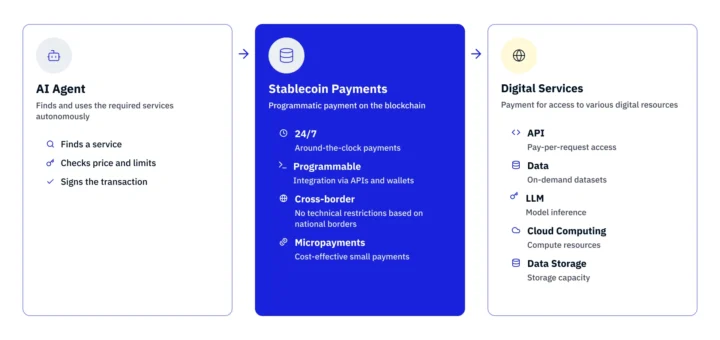
The main advantage of stablecoins for AI agents is that payments can be handled like any other programmatic operation. A system can retrieve the price of a service, check predefined limits, sign a transaction, submit it, and verify its completion within a single software workflow.
Several properties of stablecoins are particularly relevant in this context:
- 24/7 settlement. Public blockchain networks aren’t tied to bank operating hours, allowing an agent to transact whenever needed.
- Programmatic access. Fund management can be integrated into software logic through wallets and application interfaces. For an agent, a payment then becomes a machine-executable action, much like accessing an external service.
- Cross-border functionality. Digital assets aren’t subject to technical restrictions based on national borders, although in practice, the ability to deposit, withdraw, and use funds still depends on local regulations and available infrastructure.
- Support for micropayments. Many blockchain networks and batching mechanisms can reduce per-transaction costs to a level where paying for small amounts of digital resources becomes economically viable.
In April 2026, for example, Circle introduced a Nanopayments mechanism that enables USDC payments as small as $0.000001 without a separate gas fee for each transaction. Thousands of transfers are aggregated before final settlement on the distributed ledger. Traditional payment methods, meanwhile, are often economically inefficient for sub-cent transactions because of fixed transaction costs.
Stablecoin Use Cases for AI Agents
The most natural stablecoin use cases in the agentic economy emerge when a commercial service or resource is delivered programmatically. For example, an AI agent can pay for:
- Access to data
- Queries to specialized LLMs
- Cloud computing
- Data storage
- API usage
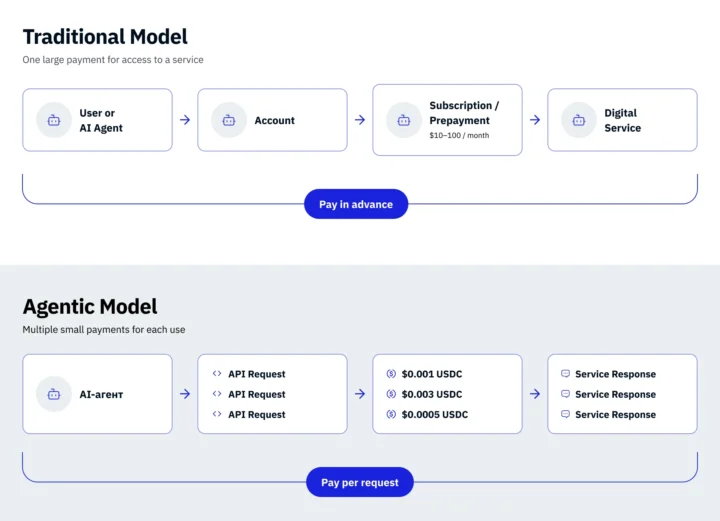
For example, access to an API that previously required registration, an API key, and a subscription could potentially be paid for on a per-request basis.
These high-frequency machine-to-machine payments are what fundamentally distinguish the agentic economy from the existing digital payments market.
Scale of Stablecoin Use in the Agentic Economy
The scale of the stablecoin market already supports viewing stablecoins as an established class of financial instruments. However, total on-chain transaction volume can’t automatically be equated with payment activity. According to an estimate by the Bank for International Settlements (BIS), stablecoin transaction volume reached around $35 trillion in 2025, while flows directly associated with payments were estimated at only about $390 billion.
Most stablecoin activity still involves various transactions within the cryptocurrency ecosystem. As a result, machine payment data provides a more relevant measure of their role in the agentic economy. In June 2026, Coinbase reported that more than 160 million agentic payments had passed through the x402 protocol over the previous 12 months. Official x402 data showed 75.4 million transactions and $24.2 million in volume over the preceding 30 days as of September 17, 2026.
This volume remains small compared with traditional payment systems, but it indicates the emergence of a distinct segment of automatically initiated payments.
Key Players in the Agentic Payments Market
In 2026, the connection between stablecoins and the agentic economy strengthened and expanded significantly through several large-scale initiatives:
- The open x402 protocol is being developed by the dedicated x402 Foundation under the Linux Foundation. The initiative brought together 40 companies across finance, cloud infrastructure, and payment technology.
- Amazon Web Services integrated x402-based payments into Amazon Bedrock AgentCore, allowing developers to set budgets for agents and enable them to independently purchase access to paid digital resources.
- Circle launched Agent Stack, a suite of tools that allows AI agents to hold USDC, discover digital services, and pay for them programmatically.
More general-purpose infrastructure is developing in parallel. For example, the Machine Payments Protocol (MPP), developed by Stripe and Tempo, isn’t tied to a single payment method. It supports stablecoins, bank cards, and other payment methods within agentic commerce.
Changes in Payment Infrastructure as the Agentic Economy Evolves
The growth of agentic payments could create new market dynamics for several categories of companies:
- Blockchain networks compete for transaction volume
- Stablecoin issuers gain an additional source of demand for their assets
- Payment protocol developers promote their own standards for interactions between agents and merchants
- Payment providers working with stablecoins can generate revenue from conversion, custody, settlement, liquidity provision, and enterprise services
The most significant change could occur among digital service providers, as stablecoins can make micropayments economically viable in certain use cases. Instead of purchasing a monthly subscription or funding an account in advance, AI agents can pay for each transaction as it occurs. This allows service providers to monetize small amounts of digital resources as they’re consumed.
Constraints on Stablecoin Use in the Agentic Economy
Their technological suitability for machine payments doesn’t make stablecoins a universal payment instrument. Their adoption is constrained by:
- Fragmentation across the blockchain ecosystem and the lack of full interoperability between networks
- Issuer and reserve risks, including the possibility of a stablecoin deviating from its peg
- Regulatory requirements, including AML rules, sanctions screening, and differences in legal frameworks across jurisdictions
- The need to convert between stablecoins and fiat currencies
- Privacy and dispute resolution considerations
- Competition from other payment methods and infrastructure solutions, including cards, instant bank transfers, and multi-rail protocols such as MPP
The role of stablecoins in the agentic economy will therefore likely depend on the use cases where their properties provide a measurable advantage. As AI agents increasingly purchase small amounts of data, computing resources, and other digital services, demand could grow for payment instruments that support large-scale automated transactions without disrupting continuous interactions between software systems.