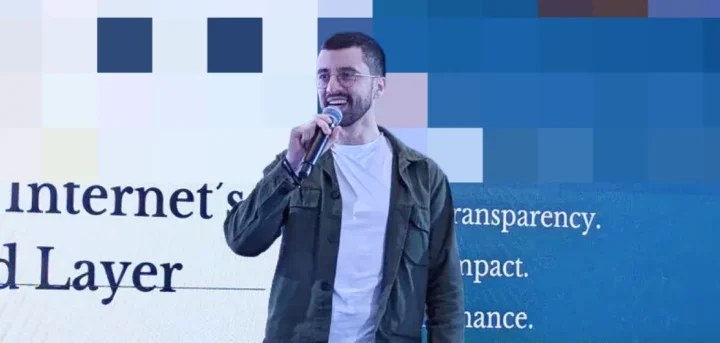
Crypto has spent the past decade evolving from ambitious technological experiments into an industry increasingly focused on real financial services. But bringing those services to everyday users requires more than functional blockchain protocols. Wallet security, user experience, regulatory compliance, and access to liquidity are becoming just as important as the underlying technology.
Coinspaid Media spoke with John O’Connor, CEO of RealFi and one of Cardano’s earliest hires, about how blockchain infrastructure has evolved, what RealFi’s mainnet launch revealed about user behavior, and why DeFi still has work to do before it can match the convenience of traditional financial services. The conversation also explores stablecoin-based savings and investing, the challenges of tokenized credit markets, and the different paths to adoption across developed and emerging economies.
From Early Blockchain Experiments to Real-World Adoption
From your early work with Cardano to your current role at RealFi, how have the challenges of building blockchain infrastructure changed?
God, it’s so different from 10 years ago. I was the first hire at Cardano, and when I joined, we were setting up the foundation in Zug, Switzerland.
I remember meeting Luka Müller at MME. He was one of the first lawyers to really start doing crypto. He was based in Zug, and he set up the Ethereum Foundation. When we were setting up Cardano, he said, “It’s incredible how many crypto foundations we have right now. If you look through this building, you’ll see we have about 35 crypto foundations set up here.” Isn’t that insane? And that was just one building. Since then, the industry has grown enormously, and Switzerland is no longer the only place people set up crypto foundations.
So 10 years ago, the competition was very small, frankly. Now it’s insane. People have tried every idea under the sun across every category. One, it’s a lot more competitive. Two, the narratives have changed, and what people value has changed dramatically.
Back then, when no one knew what the technology was useful for, no one could price it. It’s a bit like AI now. AI has much clearer current demand drivers, but trying to estimate what the world looks like with AI and where that value will accrue is very difficult. Hence, everything gets funded at insane valuations.
Now, I think people are a lot more interested in a smaller subset of things. The projects that are doing very well are actually the projects driving real revenue. Hyperliquid, for instance. I think the industry has become more discerning. Revenue, or protocol revenue, was never really something people cared about. It was big ideas — ideas like Internet Computer and Worldcoin. Imagine a world where this statement is true: what would you value this at? Then
create that value today before anything’s done. So I’d say it’s definitely grown more discerning, with a much bigger focus on technology.
You’re also starting to see vertically integrated plays working very well. For instance, Aave. They have a supply rate, and they’re like, “How do we increase distribution?” So their Irish subsidiary gets the regulatory approval needed to offer fee-free fiat-to-stablecoin on- and off-ramps. Then they’re like, “Let’s stick a front end in front of users, and basically we’re a neobank.” Zero cost in, the Aave supply rate becomes the interest on your deposits, whip together a front end, and now this is the play.
It’s no longer about crypto serving crypto users and trying to bring normies into crypto. It’s about leveraging the building blocks we’ve built to supply services to normies in a way that they’ll never really know it’s crypto, or they shouldn’t have to.
I feel like that’s the big change. With that has come a lot more focus on the regulatory side, the banking side, orchestration, compliance — all the stuff you need to bring this to the real world. That’s where a lot of the attention is. Crypto card offerings are having a great day. It’s these kinds of companies doing the picks and shovels in the gold rush that are really building valuation. I think that tells you a lot about the industry.
What have RealFi’s first weeks on mainnet taught you about running financial infrastructure in practice?
With RealFi, you’ve got the normal stablecoin, USDrf, and then you stake it. Once you stake it, you’re basically getting exposure to a portfolio of assets. Some of these are liquid; some are real-world credit, which might have a six-month duration. We have to balance that and manage that liquidity. Essentially, you’re running a fund on that side.
Testnets are all about the software part. Mainnet is all about financial operations and making sure you’re operating in a way that delivers your product successfully. You can do lots of dry runs, but launching mainnet is where all of that becomes real. I’m grateful to say the launch has gone smoothly, and we’re picking up a lot of attention on the Cardano side.
Cardano has had DeFi for a few years, but a lot of people in the ecosystem are still trying it for the first time, which is kind of fun to see. We get lots of positive comments like, “Oh my God, this is the first time I’ve tried DeFi. I love it.” That kind of thing.
The second thing I’ll say is that getting people to actually buy an asset with real money is, of course, different from getting them to try a testnet. Even some of the people who were on testnet said, “It’s all great. It’s so simple. It’s so easy.” On mainnet, they’ve got a lot more questions, which is great. We’ve got answers.
But it’s interesting: once things become real and involve real money, people’s decision-making routes are completely different. The questions you ask in a testnet are, in some ways, uncorrelated with the questions you’re going to ask when it’s real money. And that’s the way it should be.
RealFi’s testnet attracted over 3,000 verified wallets. What did you learn about the way people interact with on-chain financial services?
Look, I would say the DeFi experience in general is a lot better. People are also less willing to go through complicated experiences.
Even experienced DeFi users increasingly want complex financial transactions simplified into a single click, rather than having to navigate multiple steps across different protocols.
People used to go through incredibly complicated processes eight or nine years ago, particularly during the yield farming days, when everyone was farming points across different products.
Now, in a world of AI and convenience, people’s willingness to do manual work has dropped significantly. So I think you need user experiences that keep up with that expectation. DeFi is still not quite there, but we’re spending a lot of time trying to create these experiences for people. You can bundle transactions together so it becomes one click.
People have become less patient with poor user experiences, and I think that’s understandable.
Making Crypto Wallets Work for Everyday Users
What are the biggest challenges in making crypto wallets secure and accessible enough for everyday financial use?
I was having an interesting conversation with Blockaid, a cybersecurity firm in this space, yesterday. Look, Web2 has all the same challenges with cybersecurity and risk. I’m sure you saw the critical PHP exploits. You get one new thing every week, and that’s the nature of it. Frontier models are exposing stuff humans haven’t caught, often for decades.
But the attack surface — or at least the value exposed in Web2 examples — is typically much smaller. You can compromise the systems of a bank; it’s still very unlikely you’re going to be able to raid their bank accounts. Within crypto, you expose the value. The value is sitting there on-chain, so it’s just a much more attractive option to attack. And if you compromise it, the rewards for an attacker are ludicrous.
The other part is that you add in nation-state actors now. A lot of the recent hacks were sponsored by North Korea. Then you’ve got this push towards creating neobanking-style apps with crypto backends. So it’s a big problem.
I think crypto particularly has exposure to improvements in frontier models on the security side. More needs to be done. To give you an example, when we had all of our smart contracts audited three or four years ago, you’d do the audit and then you’re done. Now it’s more of a maintenance contract with an external security firm. Every time there is an improvement in the models, we’re basically rerunning the audits to check whether there are any critical bugs that have been missed. So we’ve shifted from security as a one-off activity at the beginning to constant maintenance in order to keep yourself safe.
Outside of security, for accessibility, seed phrases are not the way to go. You need people to be able to recover their accounts without going under their mattress and looking for their seed phrases. A lot of work has been done to split up the phrase and enable recovery through different methods. But that’s required if you want to make this useful for everyday people.
As stablecoins move beyond payments into savings and investing, how do you see the role of crypto wallets evolving?
I would say it’s become almost the key focus for a lot of players in the industry. I used the Aave example before, but you’ve got tons of other options. There’s Plasma, there’s now Ethena Pay.
This is definitely a major trend in the industry. If you look at traditional markets, Revolut and Wise have been some of the biggest winners over the last five years. The idea of being able to operate those same products with an absolute fraction of the operations, because it’s all being run essentially through smart contracts, is very appealing.
As a result, you’ll continue to see a huge focus on building distribution through this. I’m very much for this. If you look at the experience you could have in crypto five years ago versus Revolut, Wise or Monzo, they were not even comparable. The neobanks had such a better experience. That gap has dramatically closed, so I’m very positive about this.
The only thing I’ll say is that it’s important, of course, that the risks around this are also highlighted.
Trust, Transparency, and Liquidity in On-Chain Finance
What should wallets make clear to users about the risks and liquidity of yield-bearing stablecoin products?
One thing I’ve noticed is that people are not that clear about APYs. There are lots of descriptions of APYs that may be the top historical number achieved, but they’re not representative of the current number. With normal financial advertising, you’d have to be clear. You’d say, “The 30-day trailing APY is this.” You can’t say 20% because it was achieved on one day through incentives. So I think there’s a lot of clarity needed around what the product is.
Secondly, you might see a 13% APY advertised, but that only applies to the first portion of the money you put in. As the amount increases, the rate drops, and the effective APY on a larger deposit might be 3%. There’s lots of bad behavior around that.
The last part is that you’ve got to be clear about the risks to the price, and you have to be clear about the risks on the liquidity side. We endeavor to do all of that. We put up the transparency portal where you can understand the assets and what you’re exposed to with our products.
The risk, once you package that into a nice, clean consumer neobanking experience, is that you lose some of that context. And that’s a question I think the industry needs to think about.
What role should digital identity and regulatory compliance play in wallet-based financial services?
I’m in two minds about this. On the one hand, in order to attach, let’s say, a debit card or a crypto card to a non-custodial wallet, you require KYC. So I actually think there’s a balance where you can have the wallet not requiring KYC, and then once people want to spend from that balance, KYC needs to happen in order to get the cards. That’s fine.
The good thing about the current setup is that, with a lot of great KYC providers now, the operator of the wallet doesn’t need to touch the actual KYC credentials, which is really important. Holding people’s data is not good. It’s also a risk under European GDPR legislation. You really want to push that role over to someone else, which is exactly what currently happens. So from an operator’s perspective, this is kind of a good setup.
On the other hand, the requirements are often for either the operator or the KYC provider to hold your data for five, ten, twelve years, even if you close your account. So from a crypto perspective, by engaging with these services, you’re providing a lot of data that will sit around for a long time. And we’ve seen lots of hacks on these providers to get all of that information.
So I think, at least from a setup perspective, the current system kind of works. Unfortunately, we’re not at a place where that information you’ve provided decays. We’re not in a world of zero-knowledge proofs, where you’re proving your passport credentials are valid and that’s it. That’s not how the industry has evolved.
It still creates a lot of data risk, frankly, because these things sit around for years and sometimes decades. And as we’ve seen, the attackers are getting badder and badder. So will that information leak at some point? Quite possibly.
Where do you see the biggest infrastructure gaps between on-chain liquidity and traditional credit markets?
There’s a really interesting example: the Janus Henderson AAA CLO ETF. It invests in AAA-rated CLOs, and it’s got substantial trading volumes on a normal exchange. For most investors, it’s secondary-market trading rather than redeeming directly from the fund.
The market’s deep enough that you can sell it and settle T+1. Janus Henderson has also brought a similar AAA CLO strategy on-chain through the Janus Henderson Anemoy AAA CLO Fund (JAAA). And actually, most of its redemptions have settled on the same day or the next business day. Eligible holders can now also get instant USDC liquidity through additional facilities.
And that’s actually an interesting development. But redemption liquidity isn’t necessarily the same as having a deep secondary market. Everyone thinks tokenization means liquidity. You still need to build the market around that.
It would be great if we got to deep, 24/7 secondary markets for these credit products. But you still need to build demand around them.
The big narrative in crypto is “tokenize, tokenize, tokenize” these real-world assets. But to make them useful, we also need to make sure we have liquidity around them so people can use them across DeFi. And that’s actually a completely separate job.
Financial Inclusion and the Future of Crypto Adoption
Looking ahead, what would it take for wallet-based financial services to reach people underserved by traditional banking?
I think an emerging-market neobank focus is lightning in a bottle. You’ve already seen that fintechs have some of the fastest growth rates in Mexico, Nigeria — markets like this, with large populations, young populations, bad banking services and weak currencies. We know that’s a great setup for fintech to succeed.
There’s a reason why crypto neobanks are focused on these markets: it’s very expensive to move between the local currency and crypto. Even if I can do a wallet transfer on a network like Base for nothing, it doesn’t really matter if I’m paying 3% to get into the system and 3% to get out of the system. So we need to compress the on- and off-ramp costs to make these crypto neobank solutions useful.
The second part is that you want people to hold balances in their local currencies, which a lot of the regulators in these markets expressly prohibit or are just starting to engage with. But once you solve these two things, yeah, it’s going to be lightning in a bottle.
What about markets where the banking system is already well developed, such as the US, Canada and Western Europe?
The pitch there is completely different. The pitch isn’t “get a good banking experience.” You’ve already got good banking experiences. Well, you now have good banking experiences with people like Revolut, Wise and Monzo. Previously, the banking experiences were not actually good, but with the neobanks, you’ve got that.
So the real pitch becomes access to products, better savings rates and better yields. You can get T-bill yields, but if you want a bit more, can you get access to that? For instance, Aave’s supply rate.
I think it’s really about offering more products for people to do things with their money, and maybe doing more innovative products. I’ve seen a lot of product research about how people really want gamification of their money versus an extra 100 basis points of yield. I think the space to innovate on the crypto side is much easier and faster.
So I think it’s about more product opportunities and maybe making money a bit more fun.