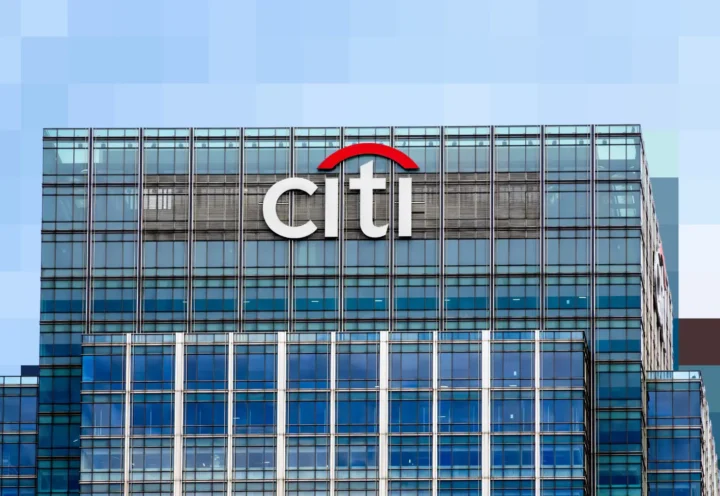
Citi projects that the global market for tokenized financial assets will expand from roughly $17 billion today to $5.5 trillion by 2030 under its base case scenario. Liquid public market instruments, including equities, U.S. Treasuries, and money market funds, are expected to be the primary growth drivers.
Tokenization of financial assets is moving beyond the experimental stage and into practical implementation, according to Tokenization 2030: Wall Street On-Chain, a report published by the Citi Institute. The authors estimate that the market could reach $2.7 trillion under a bearish scenario and $8.2 trillion under a bullish one by 2030. The sector is currently valued at approximately $17 billion, already three times larger than it was a year ago.
Tokenization refers to the creation of a digital representation of an asset, such as a stock, bond, fund, or deposit, in the form of a token issued on a blockchain network or distributed ledger. This structure can accelerate settlement, reduce manual reconciliation, and embed automated functions directly into the asset, including coupon payments, compliance checks, collateral management, shareholder voting, and securities redemption.
According to Citi Institute estimates, the tokenized asset market could be structured as follows by 2030 under the base case scenario:
- Public equities: approximately $3.6 trillion, including $2.6 trillion in the U.S. market.
- Public fixed income instruments: approximately $1.4 trillion, including $800 billion in the U.S. Treasury bills and $600 billion in money market funds.
- Real estate funds — about $200 billion.
- Private credit — about $100 billion.
- Private equity — about $100 billion.
The report’s authors believe that early adoption will be concentrated in areas where the benefits of the technology are most evident, namely liquid assets, collateral management, and settlement processes. U.S. Treasuries and money market funds are particularly well suited for tokenization because they are already widely used as collateral and cash equivalents in institutional transactions.
Another key growth factor is the development of digital forms of money designed for settlement within blockchain-based infrastructure. Citi Institute forecasts that the stablecoin market could reach $1.9 trillion by 2030. Alongside stablecoins, banks are advancing tokenized deposits. These instruments are expected to serve as the settlement layer for transactions in which asset delivery and payment occur simultaneously, reducing settlement risk.
The report also highlights growing interest from major participants in traditional financial markets. DTCC has received approval to develop a tokenization service for assets held within its custody infrastructure, with a three year pilot program planned. NYSE intends to launch a tokenized securities platform that could enable around-the-clock trading of U.S. stocks and exchange-traded funds. According to the report, Nasdaq has secured SEC approval to support the issuance, trading, and settlement of selected equities and funds in tokenized form.
Citi Institute emphasizes that the transition will not happen overnight. Traditional and tokenized infrastructure are expected to operate in parallel for years. This could temporarily increase operational complexity as market participants manage legacy recordkeeping systems, new digital registries, differing settlement frameworks, and evolving regulatory requirements simultaneously.
The lack of common standards, limited interoperability across platforms, fragmented liquidity, and legal uncertainty in certain jurisdictions remain major obstacles. The report also notes that issuing a token does not automatically create liquidity. If the underlying asset trades infrequently or has a limited buyer base, tokenization does not alter its fundamental economics.
The authors take a more cautious view of private markets. Despite growing interest in tokenizing private credit, private equity funds, and real estate assets, these segments remain challenging due to limited liquidity, retail investor restrictions, long holding periods, and the significant role of relationship-driven dealmaking.
The report’s central conclusion is that tokenization is not replacing existing financial markets but adding a new infrastructure layer. Its success will depend not only on technology, but also on regulation, confidence in settlement assets, participation by major financial institutions, and the ability of market participants to integrate traditional and digital systems within a unified framework.
Recent developments illustrate this trend. In the United States, the benchmark iBoxx U.S. Treasuries index family, which tracks key segments of the traditional bond market, has been tokenized. In the European Union, the Seturion blockchain platform is being used to build a pan-European infrastructure for the settlement of tokenized securities.