
- 1/8
- 2/8
- 3/8
- 4/8
- 5/8 Crypto POS Explained: What Happens When Customers Pay with Cryptocurrency
- 6/8
- 7/8
- 8/8
The use of cryptocurrency is increasingly extending beyond investment and trading. More consumers are looking for ways to spend their digital assets in everyday life — online shopping, travel bookings, or for payments for goods and services. According to the National Cryptocurrency Association, nearly 39% of cryptocurrency holders used it for shopping in 2025.
Yet the transition from holding crypto to spending it remains uneven. While online payments have seen steady growth, using cryptocurrency in physical stores presents a set of challenges. This is where crypto point-of-sale (POS) solutions come in. Designed to integrate cryptocurrency payments into existing retail operations, they provide merchants with a structured way to accept digital assets while maintaining visibility over transaction status, settlement, and reporting.
Why Crypto Payments in Physical Retail Remain Uneven
Accepting cryptocurrency at the point of sale involves more than generating a wallet address and displaying a QR code. Retail environments operate under strict requirements around transaction speed, operational efficiency, and financial reporting, creating a number of challenges for merchants:
- Checkout speed. Customers expect transactions to be completed within seconds, while payment confirmation times can vary depending on the blockchain network being used.
- Staff workflows. Cashiers need clear procedures for handling successful, failed, or pending transactions without disrupting the checkout process.
- Price volatility. The value of a digital asset can fluctuate between the moment a payment amount is displayed and when the transaction is completed.
- Refund management. Unlike card payments, crypto transactions are generally irreversible, requiring separate refund procedures.
- Accounting and reconciliation. Merchants need to match sales records with on-chain transactions and account for any conversions between cryptocurrencies and fiat currencies.
- Compliance and settlement requirements. Depending on the jurisdiction, businesses may face different regulatory obligations, reporting requirements, and settlement options.
These operational considerations help explain why cryptocurrency payments have not followed the same adoption path across all retail segments. They have also driven demand for dedicated tools that can integrate blockchain payments into existing checkout processes. While these considerations are often cited as barriers to adoption, merchants’ concerns do not always match the realities of implementation.
According to Vadzim Nikifarau, POS Business Development Director at CryptoProcessing, one of the providers of crypto POS solutions, “there is a common misconception that accepting cryptocurrency requires merchants to manage digital wallets, hold crypto assets on their balance sheet, or deal with significant price volatility. In reality, modern crypto POS solutions can automatically convert cryptocurrency payments into fiat currency, allowing merchants to receive settlements in their preferred currency while minimizing exposure to market fluctuations.”
Meanwhile, operational, not technological, constraints are considered to be the actual challenges. “Merchants want to ensure that crypto payments fit seamlessly into existing checkout processes, accounting workflows, and staff operations. Questions around transaction speed, payment confirmation, reconciliation, and regulatory compliance tend to be more important than the technology itself,” he said.
What Is a Crypto POS Terminal?
A crypto point-of-sale (POS) terminal is a payment solution that enables merchants to accept cryptocurrency payments in a structured retail environment. Rather than relying on manual wallet-to-wallet transfers, a crypto POS system is designed to support the checkout process by generating payment requests, tracking transaction status, and providing records for reconciliation and reporting.
Most crypto POS solutions include several core capabilities:
- Generation of payment requests based on the purchase amount
- QR code creation with embedded payment details
- Real-time transaction status tracking
- Settlement and conversion options, depending on the provider
- Transaction history and reporting tools for reconciliation
It is also important to distinguish a crypto POS terminal from a simple wallet QR code. While a static wallet address allows customers to send funds directly, it typically does not provide transaction management, cashier workflows, reporting tools, or settlement functionality. A crypto POS solution is designed to provide merchants with transaction management, payment tracking, and settlement capabilities rather than simply facilitating the transfer of digital assets.
How Crypto POS Payments Work
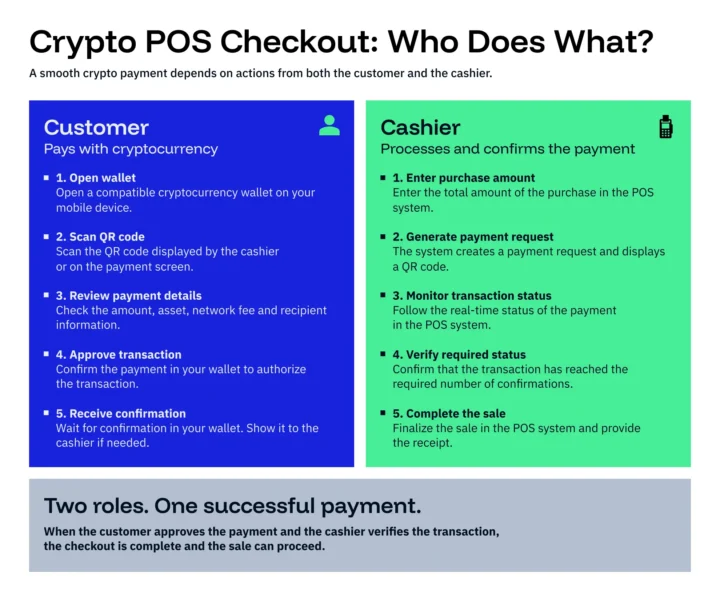
From the customer’s perspective, a crypto POS transaction is typically reduced to a simple interaction: scan a QR code, approve the payment, and receive confirmation. Behind the scenes, however, several steps take place to connect the purchase with blockchain settlement.
A typical payment flow looks as follows:
- The cashier enters the purchase amount.
- The system generates a payment request and displays a QR code.
- The customer scans the code using a compatible cryptocurrency wallet.
- The customer reviews the payment details and authorizes the transaction.
- The transaction is broadcast to the blockchain network.
- The merchant receives a status update based on the configured confirmation requirements.
- The sale is completed, and the funds are processed according to the merchant’s settlement preferences.
What happens next depends on the merchant’s setup. Some businesses choose to retain the received cryptocurrency, while others prefer to convert it into another digital asset or fiat currency. Available settlement options vary by provider, supported assets, and jurisdiction.
The Customer and Cashier Experience
For most users, the appeal of crypto payments lies in their simplicity. A customer is typically presented with a QR code, scans it using a compatible wallet, reviews the payment details, and authorizes the transaction. If everything proceeds as expected, the interaction can take only a few moments.
However, a successful checkout experience depends on more than the customer’s actions. Store staff also need clear guidance on how to handle cryptocurrency payments within the broader sales process.
For customers, the main requirements are relatively straightforward:
- Access to a compatible cryptocurrency wallet
- Sufficient balance of the required asset
- Understanding of any applicable network fees
For cashiers, the focus is operational:
- Knowing which payment status is sufficient to complete the sale
- Recognizing the difference between pending and completed transactions
- Following established procedures if a payment fails or is delayed
As with any payment method, customer confidence often depends on consistency. The less additional explanation required during checkout, the more naturally cryptocurrency payments can fit into existing retail workflows.
Where Crypto POS Fits Best
Crypto POS solutions are not limited to a specific type of business. However, adoption tends to be strongest in sectors that frequently serve international customers, process higher-value transactions, or already see demand for cryptocurrency payments.
According to Vadzim Nikifarau, interest is growing across several sectors, with particularly strong demand coming from hospitality, luxury retail, travel, automotive, and businesses serving international customers.
“These merchants are often looking for additional payment options that align with the preferences of a global and digitally savvy customer base,” said Vadzim.
Examples include:
- Retail, particularly stores targeting tech-savvy or internationally mobile customers.
- Hospitality and HoReCa, where businesses can offer an additional payment option without significantly changing existing checkout processes.
- Travel services, including agencies, booking providers, and businesses serving international visitors.
- Luxury and premium goods, where customers are often familiar with alternative payment methods and cross-border transactions.
- Beauty and wellness services, where appointment-based payments can be integrated into existing checkout workflows.
Real-world deployments are already beginning to emerge. In 2026, CryptoProcessing by Coinspaid launched a pilot program in Estonia to enable cryptocurrency payments in physical stores using POS infrastructure powered by Flowgate. The first implementation was deployed at jewelry retailer Kuldan, allowing customers to pay with digital assets while giving the merchant the option to settle either in cryptocurrency or euros. The rollout was designed to work alongside existing checkout systems rather than require a complete replacement of retail infrastructure.
How to Evaluate a Crypto POS Provider
While crypto POS solutions share the same core purpose, their capabilities can vary significantly. According to Vadzim Nikifarau, merchants evaluating crypto POS solutions tend to focus on practical business considerations rather than technical specifications. “Merchants typically focus on three areas: simplicity, reliability, and business value. They want a solution that can be integrated with minimal disruption to existing operations, and that requires little additional staff training. Transaction speed and ease of use at the point of sale are critical, particularly in retail and hospitality environments where customer experience is a priority,” said Nikifarau.
Before selecting a provider, merchants should consider several key factors:
- Supported cryptocurrencies and networks. The range of available assets and blockchain networks can influence customer adoption, transaction costs, and payment flexibility.
- Settlement options. Merchants should understand whether payments can be settled in cryptocurrency, converted into another digital asset, or received in fiat currency where available.
- Reporting and reconciliation tools. Access to transaction history, exports, and operational reporting can simplify financial management and day-to-day administration.
- Integration requirements. Some solutions can be deployed using existing devices and workflows, while others may require additional hardware or technical customization.
- User management and access controls. Businesses operating across multiple locations may benefit from role-based permissions, cashier management, and activity tracking.
- Compliance and security features. Depending on the business model and jurisdiction, transaction monitoring, audit trails, and other compliance-related tools may be important considerations.
- Customer experience. The payment process should be intuitive for both customers and staff, minimizing friction at checkout.
Ultimately, the most suitable crypto POS solution is not necessarily the one with the broadest feature set, but the one that best aligns with a merchant’s operational requirements, customer expectations, and preferred settlement model.
As cryptocurrency moves beyond investment use cases and into everyday commerce, merchants are increasingly evaluating how digital assets can fit into real-world payment environments. Crypto POS solutions offer a practical way to bridge blockchain-based payments and retail operations, helping businesses integrate cryptocurrency into existing checkout processes.
FAQ
The legality of accepting cryptocurrency depends on the jurisdiction in which a business operates. In many countries, merchants can legally accept digital assets as a form of payment, although regulatory, tax, and reporting requirements may vary.
According to Vadzim Nikifarau, POS Business Development Director at CryptoProcessing, one common misconception is that cryptocurrency payments in physical stores are either unregulated or prohibited by default. In practice, the regulatory treatment of crypto payments varies by market, making it important for businesses to understand local requirements and work with providers that support compliance, reporting, and transaction monitoring where required.
Businesses should review applicable regulations and consult legal or tax advisors before implementing cryptocurrency payments.
Not necessarily. Most modern crypto POS solutions are designed for everyday retail use and do not require merchants or cashiers to have in-depth knowledge of blockchain technology. Day-to-day operations are typically managed through familiar interfaces and payment workflows.
The cost of a crypto POS deployment can vary depending on the provider, the scale of the business, and the level of integration required. Key factors may include transaction processing fees, settlement preferences, the number of locations or users, and any customization or integration work needed to connect the solution with existing systems. Businesses should also consider ongoing operational costs, such as payment processing and support services, when evaluating a provider.
Not always. Many crypto POS solutions can operate on existing devices such as smartphones, tablets, or web-enabled terminals, reducing the need for specialized equipment.
In many cases, yes. Some solutions are designed to work alongside existing POS infrastructure, allowing merchants to add cryptocurrency payments without replacing their current checkout setup.
Typically, yes. Providers often allow merchants to enable or disable specific assets based on business preferences, customer demand, or settlement requirements.
Most systems automatically expire unpaid payment requests after a predefined period. If a transaction is not completed, the merchant can generate a new payment request and continue the checkout process.